

Can Therapists Use Tarot in Therapy?
In therapeutic circles, professionals are talking more and more about using unconventional practices with their clients. Gone are the days of the stiff, stone faced psychoanalyst who would ask “how does me not answering your question make you feel?” instead of answering a question from a client. The era of the relatable therapist has been ushered in by younger therapists, as well as the field shifting to counselors and social workers instead of decades past when clinicians were mainly psychologists. A search of professionals listed on Psychology Today will likely find more mental health professionals that look like your next door neighbor or a kindergarten teacher than they do Sigmund Freud. They might even be covered in tattoos or have a brightly colored mohawk in some areas of the country!
One benefit to having younger and more eclectic counselors and therapists in practice is that the ideas about what therapy is supposed to be have shifted, especially over the last 15-20 years. Behavioral-based models like Cognitive behavioral therapy (CBT) have fallen out of popularity as more intuitive modalities like Internal Family Systems (IFS) have become more popular. If a client utilizes practices like tarot, astrology, or intuitive work in their daily life and their therapist is familiar and comfortable with those practices, why wouldn’t they be appropriate for use in therapy?
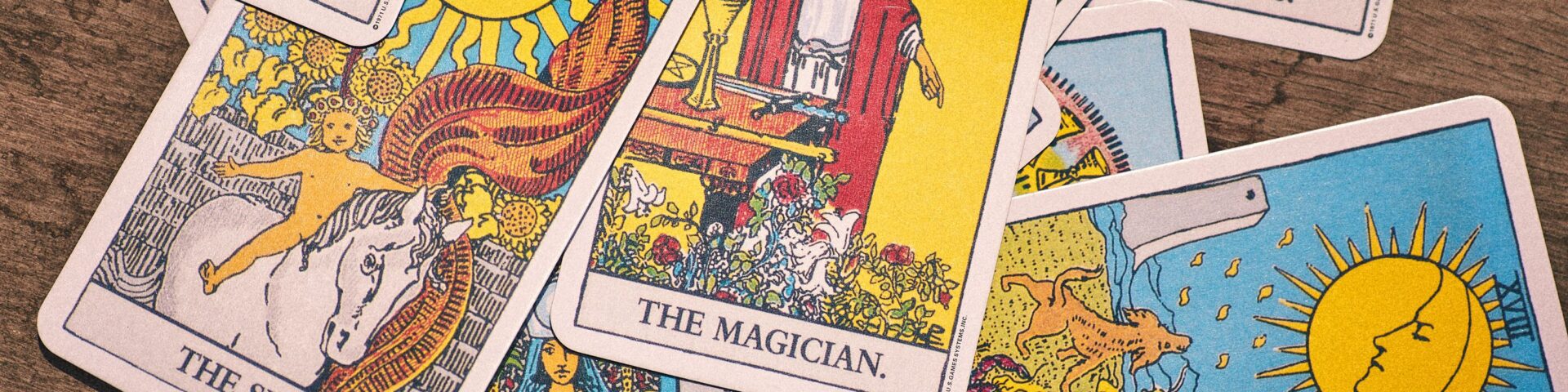
“Tarot is visual imagery, which art therapists use all the time.”
– Dreya Blume, LCSW, “The Clinical Use of Tarot Card Imagery in Psychotherapy Volume1.”
Using Astrology or Tarot in Therapy is Not Ethical (Some People Say!)
The sentiment that it’s unethical to use tarot or astrology in therapy is not uncommon to see within professional circles online. Not long ago, I saw someone telling another professional on the r/therapists subreddit that using tarot was unethical. Leading expert on the clinical use of tarot, Dreya Blume, LCSW, writes in her book “The Clinical use of Tarot Card Imagery in Psychotherapy Volume One”: “…I invariably received disparaging comments from other therapists insisting that what I was doing was ‘unethical’ and that I should be reported to my licensing board.” Misconceptions like these are why many professionals do not feel comfortable advertising that they are open to using nontraditional practices with clients, even if they do. Another clinician, Dr. Tina Vitolo, LCSW has written a new book, “The Black Sheep Therapist: Integrating Spiritual and Energy-Based Modalities in Your Clinical Practice-Ethically, Intentionally, and Unapologetically,” which specifically addresses the accusation that using astrology or tarot is unethical. While the knee-jerk reaction of some professionals may be that it is unethical to include metaphysical or esoteric practices in sessions, when a client wishes to do so there is nothing in the code of ethics of any professional organization that prohibits it.
There are Christian Counselors, So Why Can’t there be Spiritual Therapists too?
It’s important to note that when Dr. Vitolo references “spiritual” in the title of her book that I reference above, she’s talking about “spiritual not religious” practices rather than the spirituality of a specific religious practice. Many religious based counselors exist and are extremely open about it in their marketing. There are even programs of study that are specifically for training professionals in religious-based counseling. A quick search of my zip code on Psychology Today brings up over 100 counselors and therapists who self-identify as Christian and only 11 who identify as “secular and non-religious.” While not all who identify as Christian offer “Christian counseling,” here are a few quotes from the professional profiles I found:
- “I specialize in Christian-based support.”
- “I am a Christian therapist who approaches therapy with a Biblical foundation and integrates both theological and psychological approaches to best aid my clients. “
- “Having been a senior pastor for 20 years molded me to understand the various issues people encounter in life.”
- “I minister to women & couples who need help working to strengthen their perspective and relationship with Christ through a biblical understanding.”
- “Mission: Helping clients decipher what is keeping them from their purpose in Christ.”
- “I am a pastor with a Bachelor in Christian Ministry.”
- “My clients are looking for a therapist who honors their spirituality, culture, and lived experience.”
- “I use a wholistic [sic], faith-based approach and strength-based perspective.”
- “God has given me a heart full of compassion and a strong desire to help others… I use Biblical principles and psychological truths.”
- “Helping clients achieve success and work through difficult situations is my ministry.”
- “I am a Christian and welcome clients both who profess to be a Christian and who do not.”
- “My Christian worldview guides how I care for my clients with dignity and inherent value.“
- “I have 30 years experience in pastoral ministry.”
- “I utilize an integrated approach that synthesizes my Christian values with research-based practices.”
These are not from the same profile by the way, these are from 14 different Psychology Today profiles.
If it is not unethical for a counselor to integrate their own religious faith into professional counseling and therapy, why would it be unethical to integrate other spiritual practices?
Mississippi is a very evangelical Christian state. I am sure that most of the profiles of therapists in places like New York or Portland are different from the ones I have highlighted here. There may be professionals in larger metropolitan areas who feel comfortable making statements like the ones above about religions other than Christianity or those who are open about incorporating esoteric spiritual practices. But from what professionals say in therapist-only circles, many in any area of the country are still afraid to advertise using tarot, astrology, or other unconventional practices.
Clients are Searching for a “Witchy” Therapist and Astrology Informed Therapy but Can’t Find It
Coincidentally, as I was writing and researching this post, I came across a Substack post about this exact subject. Even in New York state, a place that is much more religiously diverse and secular than Mississippi, the author shares her struggle looking for a Bipoc therapist with a spiritual orientation. It’s a great post, I highly recommend reading it, whether you are a mental health professional or not. She also shares a screen capture of a thread on Threads where others also express being unable to find someone who is “spiritual non-religious” or “witchy goddess.” It’s notable that she points out: “708 likes on one post. Almost 200 comments in another…” People are looking for mental health professionals who also care about the things that they care about, who practice spirituality in the ways that they do, or at least are knowledgeable about these practices, but they can’t find us.
I Don’t Want To Alienate Other Clients
 Sometimes, therapists will say that they don’t want to “broadcast” their spiritual beliefs and practices, or that they utilize non-traditional practices in session with clients, because they are afraid of alienating clients who do not practice the same things. This is something that I have struggled with myself, especially as someone who has provided openly secular therapy for my entire time in private practice. I have positioned myself as the opposite of the “Christian counselor,” because I most certainly am. “If I have religious beliefs, you shouldn’t know what they are,” I have said to clients many times before, to reassure them that I won’t be telling them to pray, or worse yet “pray the gay away.” Because Christianity is the dominant religion in the United States, most clients who have been wounded by religion were wounded by Christianity.
In spite of opening up to the idea of integrating non-traditional elements to therapy when clients wish, my therapy with secular clients will still and always remain secular. When I have spoken to clients who have been harmed by Christian counselors, it is always because of an assumption that all clients will benefit from and be comforted by things like prayer, a god, and a spiritual framework. Or worse yet that all clients should benefit from integrating Christianity into counseling. I would never assume that a client would be interested in something like astrology, crystals, or tarot, because I would also never assume that a client would be interested in something like prayer or necessarily believes in a deity. Assuming always leads to mistakes, especially in counseling and therapy. At its worst, assuming is harmful to clients. Just as I now discuss during intakes with religious clients whether or not their religion is something they want integrated into our work, I will do the same with clients who want to use other spiritual practices.

“By using astrology as a complementary framework for self-exploration, therapists can gain deeper insights into their clients’ personalities, emotional patterns, and life challenges.”
– Wendy Hawkins, LCSW
Meeting Clients Where They Are
In mental health, we say that we “meet clients where they are.” The fact that clients are searching for witchy therapists that integrate less conventional practices like tarot and astrology into sessions and cannot find them is an issue. That some clients report being afraid of being judged by a clinician if they mention a belief in things like astrology or use of tarot is also a big issue! All clients need to feel comfortable sharing scared parts of themselves with therapists. Clients may have experienced rejection or ridicule by friends, family, or even other clinicians for their belief in and use of these practices. All parts of the client need to be safe and welcome in therapy.
Facing our own fears as clinicians so that we can openly let these clients know that they are safe with us is, in my opinion, our ethical imperative.
To Those That Want To Argue…
Don’t at me about this unless you have a rational, logical explanation for why religious based counseling is fine if it’s Christian but spiritual counseling isn’t acceptable. Something beyond that Christianity is the most popular religion in the United States. I don’t argue with strangers on the internet as a mental health practice.
Are you a mental health professional interested in learning more about integrating unconventional practices into clinical practice? Check out my podcast, The Witchy Therapist Podcast.

Stacey Aldridge, LCSW, CHHWC, RM
Stacey is a Licensed Clinical Social Worker, Certified Holistic Health & Wellness Coach, and Reiki Master. She is the co-host of The Witchy Therapist podcast, a podcast for unconventional professionals and the clients that want to work with them. She is the owner of Inspired Happiness Therapy & Wellness, LLC, a mental health private practice, and Kaya Holistic Wellness, LLC, a holistic wellness service. Stacey graduated from Belhaven University with a Bachelor of Arts in Social Services and Jackson State University with a Master of Social Work (MSW.) She has been working in the mental health field for over 15 years and has been working in private practice since 2020. Prior to private practice, she worked in hospital settings, hospice, and for NAMI, the National Alliance on Mental Illness.
Late diagnosed with ADHD in her 40s herself, Stacey is passionate about working with women and LGBTQ+ folx who have late diagnosed ADHD and autism; those who are struggling with relationship issues; and individuals who are navigating life transitions including perimenopause. Stacey lives in Ridgeland, MS with her spouse Jon and their 3 senior dogs. In her “free time” she enjoys spending time outside gardening and hiking, making a variety of crafts, doing spell work, and listening to podcasts and metalcore music.


